Trust
No Watermark Is Not Proof
 Alvin Omozokpia5 min read ·

On this page
Suppose a customer requests a refund for a damaged jug. They attach a photograph. Your product checks it for an AI watermark, finds none, and puts a reassuring green badge beside the claim.
What, exactly, has passed?
The absence of a supported watermark does not establish that the jug arrived broken. It does not establish that this is the customer's jug. Even an entirely genuine photograph could show damage from another order.
This is a fictional workflow, but a useful product decision: should evidence about a file's origin be allowed to settle the claim attached to it?
A check needs a smaller promise
On October 7, Google opened SynthID Detector globally in English for images, video, and audio. Its announcement names Google and participating partners, including OpenAI, NVIDIA, and Kakao, with Apple still upcoming. That expands access to a useful provenance signal. It does not establish coverage of every generator or every historical output. Google's announcement.
DeepMind describes SynthID as a watermarking system for AI-generated or altered content. That last distinction matters. A photo can contain an AI edit without every object in it being invented. Conversely, an unmarked file may have come through a production route outside the check's coverage.
The product should report the test it performed. "No supported watermark found" is a narrower claim than "Authentic photo." The second label lends authority the first result has not earned.
I would keep provenance evidence separate from the refund decision. Test whether that separation reduces unsupported approvals and denials at an acceptable handling cost. If the existing workflow performs as well with less effort, there is no reason to add the extra interface.
File history and claim truth are different questions
A watermark check asks about a detectable signal. Content Credentials can carry signed information about an asset's origin and changes. A refund reviewer needs to establish something else: whether the evidence supports this customer's account of this order.
The C2PA explainer makes the boundary explicit. Provenance alone cannot establish whether depicted content is factual. It also cautions against assuming that media without credentials is untrustworthy. Valid history and missing history are both easy to overinterpret.
Consider the chipped jug again. A signed photograph of the wrong jug still fails to support the refund. An ordinary camera photo without credentials may support it perfectly well once the order and damage are checked. An AI-retouched background may be irrelevant to the broken handle.
A provenance result can change what a reviewer asks next. It should not quietly change the question the product claims to have answered.
Rehearse the decision before connecting a detector
The following is an original acceptance exercise. Every input and expected response is synthetic. These are product requirements to test, not observed detector outputs or measured customer outcomes.
Assume a refund policy requires evidence linking the damaged item to the order. In this exercise, a watermark result alone is insufficient for either approval or denial. A separate source can establish the order link; missing provenance need not hold up an otherwise supported refund.
Refund-photo rehearsal: six evidence states
- Ordinary camera photo, no watermark found, order link established: preserve the negative watermark result. Allow the ordinary refund policy to proceed. Do not add an authenticity badge.
- Image from an unsupported generator, no watermark found, order link missing: show the same narrow watermark result. Ask for order-linked evidence. Never convert absence into a camera-origin claim.
- Photo with an AI background edit, watermark found, damage independently supported: record the detected signal and assess the relevant damage evidence. Do not deny the claim solely because AI touched the file.
- Valid signed history, photograph belongs to a different order: preserve the valid provenance result, but return the claim for correction. Valid history cannot repair the order mismatch.
- Verification service unavailable: report that the check did not complete. Follow the workflow's explicit fallback. Never store the outage as no watermark found.
- File replaced after verification: keep the earlier result attached to the earlier file. Mark the replacement unchecked and reassess any evidence that depended on the old version.
The first two cases deliberately share a detector result and need different handling. A system that sees only that result cannot distinguish them. The third case catches the opposite shortcut: treating any AI involvement as disqualifying evidence.
Keep the record modest. Attach the check type, result, coverage, and time to the exact submitted file, then record the claim decision and its separate evidence. A changed file needs a new assessment. Access and retention rules should cover this record; keeping evidence does not require keeping customer uploads forever.
Combining signals does not create certainty
An October 2 preprint by researchers at Original Pictures Technologies compares open watermarking and fingerprinting methods. In one image comparison, their successes covered different transformed copies. Combining those successes covered more copies than either method alone. The paper also shows why a candidate match must be verified rather than treated as an identity verdict. Watermarks and Fingerprints as Soft Bindings.
This is an early, company-authored benchmark of open methods, not an evaluation of the newly public SynthID service. Its watermark image corpus contains 85 images, and its product-catalogue fingerprinting results have their own limits. The lesson for this design is modest: each signal needs a stated interpretation, even when several are available.
Do not multiply confidence scores together and call the result a probability of truth. The checks may share failure modes, and the claim may be wrong for a reason none of them examines. In the jug example, proving which software handled the image still does not identify the order.
Unknown should not become an endless queue
There is a practical objection to all of this. Customers want their refund, and reviewers already have enough work. An interface that sends every uncredentialed image for investigation can punish ordinary people for using ordinary cameras.
Keep the provenance detail collapsed until it affects the decision. Let established low-cost refund rules continue where appropriate. In a controlled capture workflow, verified capture evidence may carry much more weight because the product knows the device, session, and order. That is a different evidence chain, not a stronger interpretation of an absent watermark.
Before release, compare the proposed evidence view with the current workflow using the same independently adjudicated cases. Include routine photos, permitted edits, wrong-order images, and unavailable checks. Measure unsupported approvals and denials separately, alongside handling time and requests for additional evidence. A design that avoids mistakes by refusing every claim should fail.
Set the acceptable review burden before seeing the results. If the existing workflow handles these distinctions reliably with less effort, keep it. The purpose is a better decision, not a more impressive verification panel.
For the unresolved cases, The Exception Queue Is the Product explains what a reviewer needs in order to act. Designing AI That Knows When to Stop covers the uncertainty states around that handoff. Start with one label in your own product: when it says "verified," what evidence would a person reasonably believe you checked?
Source and product-documentation review: October 11, 2026. This article does not test detector accuracy. The cover is an AI-generated conceptual illustration, not evidence from a refund case.
Related Posts

Trust
The System Prompt Is Not a Permission BoundaryIf the prompt says one thing but the runtime can reach another, the runtime wins. Consequential agents need a machine-verified environment receipt before they start.
Trust
When Helpful Memory Becomes SurveillanceAI memory earns its place when people can see what was retained, why it matters, where it is used, and how to change or remove it.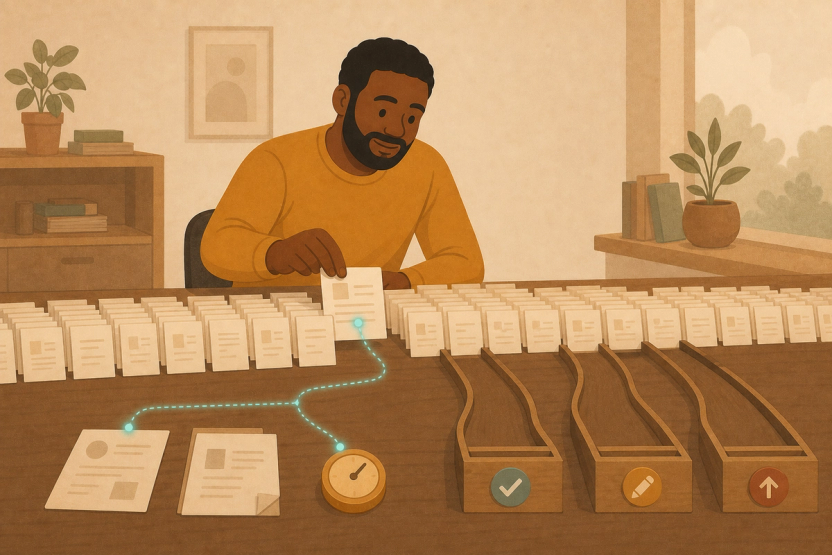
Trust
The Exception Queue Is the ProductHuman review is not a safety feature by itself. The queue must show why a case arrived, what could go wrong, who can act, and what the system should learn from the decision.