
Blog
Notes from building, studying, and leading products.

Strategy
Your AI Rollout Needs a Review BudgetMore drafts can mean more waiting. A five-case capacity model shows what an AI rollout must prove before it promises faster delivery.
Trust
No Watermark Is Not ProofA media-provenance result can describe a file without settling the claim it supports. Six refund-photo cases show where a product must keep those decisions separate.
Strategy
Your Agent Can Win the Wrong DealBefore improving an agent's negotiating skill, check whose preferences it is optimizing. A five-book example shows how 90% agreement can still miss the choice that matters.
Shipping
The Call Can End Before the Work DoesA voice agent can stop speaking while its last action is still unresolved. Three interruption replays show what a product must preserve before work continues in text.
Building
My Library Has a Genie in ItBooks, candlelight, a brass lamp, and the fun of building a little world you can walk into.
Strategy
When the Tutor Leaves the RoomAI can make a study session feel successful without showing what the learner can do alone. A worked assessment brief separates useful assistance from a credible learning claim.
Strategy
Your AI Analyst Needs to Name the DenominatorCorrect arithmetic can answer the wrong business question. A reproducible activation example shows when an AI analyst should use a governed definition, compare interpretations, or ask.
Trust
The System Prompt Is Not a Permission BoundaryIf the prompt says one thing but the runtime can reach another, the runtime wins. Consequential agents need a machine-verified environment receipt before they start.
Shipping
Your Agent Eval Should Survive a Vendor SwapModels and frameworks will change. The task, failure rules, trace evidence, and release threshold should travel together, or every migration resets what the team knows.
Teardowns
Teardown: The Leaderboard Is a Product. You Are Not the User.A 16-month study of Chatbot Arena found private variant testing, selective score disclosure, and unequal data access shaping the rankings teams treat as ground truth. The teardown lesson: leaderboards gate attention, and your release pipeline has to gate everything else.
Decision Docs
Decision Doc: A PRD Where the Core Feature Is Saying NoThe sanitized PRD for teaching a compliance-bound research assistant to refuse low-confidence requests, which cut unsupported claims from 14 percent to 1.8 percent at the cost of a 9 percent refusal rate.
Decision Docs
Decision Doc: The Experiment Brief That Replaced Our Offline EvalsThe actual experiment brief I wrote when our offline evaluation scores turned out to have near-zero correlation with production outcomes, and the shadow-mode replay design that replaced them.
Decision Docs
Decision Doc: The Memo That Stopped a CTO-Sponsored AI InitiativeThe actual hold memo I wrote after a three-week feasibility test found a 71 percent accuracy ceiling against a 95 percent requirement, and how the team was redirected without losing the sponsor.
Teardowns
Teardown: AI Search Ships Answers. The Missing Feature Is Doubt.Eight AI search engines answered wrong more than 60 percent of the time on a basic citation task, and almost never declined to answer. The teardown lesson for product teams is that abstention is a feature you have to build, budget, and own.
Strategy
A Product Note Is Not Evidence YetA note becomes useful when the observation, interpretation, and affected assumption stay connected. Living Fieldbook is a prototype for making that chain visible.
Trust
When Helpful Memory Becomes SurveillanceAI memory earns its place when people can see what was retained, why it matters, where it is used, and how to change or remove it.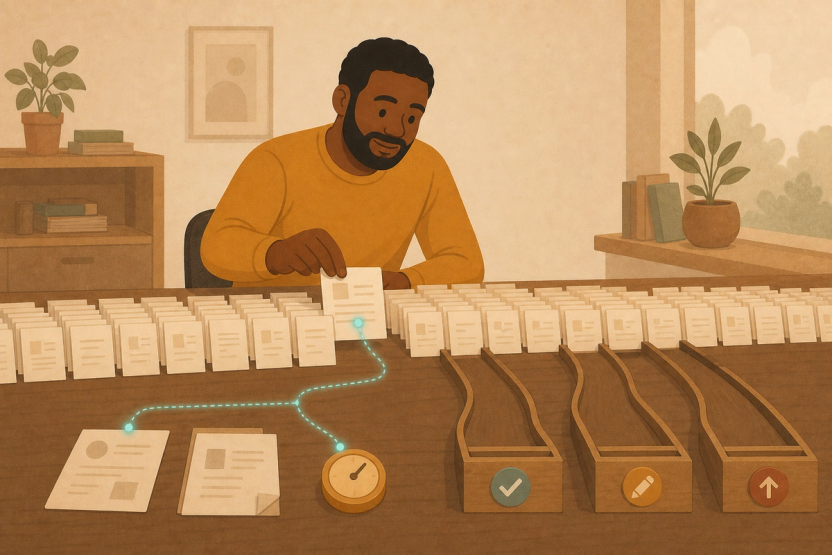
Trust
The Exception Queue Is the ProductHuman review is not a safety feature by itself. The queue must show why a case arrived, what could go wrong, who can act, and what the system should learn from the decision.
Trust
The Compliance Boundary PMs Must Draw Before RoadmappingA career assistant that helps a person tell their story and a system that ranks people for an employer may use similar technology, but they create different product, evidence, and regulatory responsibilities.
Shipping
The AI Feature Ship GateAn eval should behave like an executable product requirement: it defines the expected outcome, the unacceptable failures, and the evidence required to launch.
Shipping
Adoption Is Not an AI Value MetricAdoption shows that people used an AI feature. This metric tree tests whether the feature completed useful work at an acceptable cost and risk.
Shipping
The Cost of a Correct AnswerAI economics should be measured through correct outcomes, recovery burden, latency, and reliability, not a token price or unit-cost headline in isolation.
Trust
The Agent Autonomy BudgetA practical ladder for deciding what an AI agent may recommend, draft, or do, before convenience turns into an unacceptable product risk.
Trust
The Incident-Ready AI Product ManagerWhen an AI feature fails in production, the PM needs a severity model, containment decision, user remedy, replay path, and a way to turn the failure into a stronger ship gate.
Trust
Red-Team the Product, Not Just the ModelA model can refuse a malicious prompt in a lab and still sit inside a product that leaks data through tools, permissions, identity, or recovery gaps.
Shipping
Your AI Product Is Only as Ready as Its DataChoose the use case before the model. This Data Readiness Contract makes purpose, provenance, permissions, quality, freshness, evaluation, retention, and ownership explicit.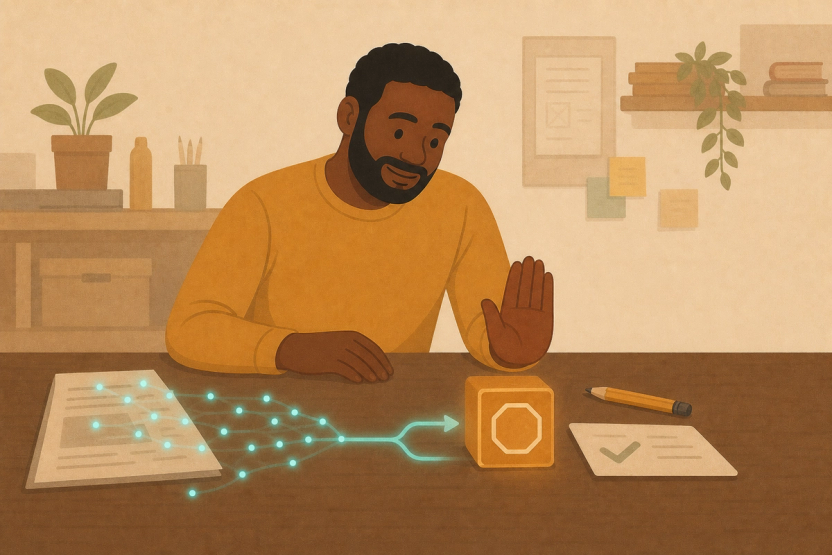
Trust
Designing AI That Knows When to StopA trustworthy AI experience does more than display confidence. It helps people inspect evidence, recognize uncertainty, stop safely, and recover when the system is wrong.
Strategy
A Product Why Must Change a DecisionPurpose is useful only when it changes scope, sequencing, evidence, or a stop decision. This brief turns an inspiring why into an operating constraint a product team can actually use.
Shipping
Building Bragora Around User ControlBragora began with a simple product problem: useful career evidence disappears when people need it most. Building the product taught me to treat capture, reuse, and AI control as one connected workflow.
Shipping
The Art of the Ask: Prompting as a Product DisciplineThe best prompts are not clever incantations. They are small product specifications that define the task, context, constraints, evidence, and acceptance test before an AI system begins.
Strategy
Duolingo Designed for the Return, Not Just the StreakDuolingo's product lesson is deeper than gamification. Its habit system reduces the cost of starting, makes continuity visible, creates recovery paths, and keeps the learning outcome close enough to matter.
Strategy
Product-Led Growth Starts After Sign-UpA free tier can generate accounts without creating a growth engine. Product-led growth works only when users reach value, return for it, and encounter an expansion path that fits the job they are already doing.
Strategy
AI Can Do PM Tasks Without Owning the Product DecisionThe useful question is not whether AI can write a PRD or analyze feedback. It is which product tasks can be delegated, what evidence the system needs, and who remains accountable for the decision.
Shipping
Faster Prototypes Need Better EvidenceGenerative AI can make a prototype cheap enough to build before a meeting. That speed is useful only when the team is explicit about which assumption the artifact tests and what evidence would change the roadmap.